The O Antiphons for December 17 to 23
By The Quiethaven Editorial Team ·
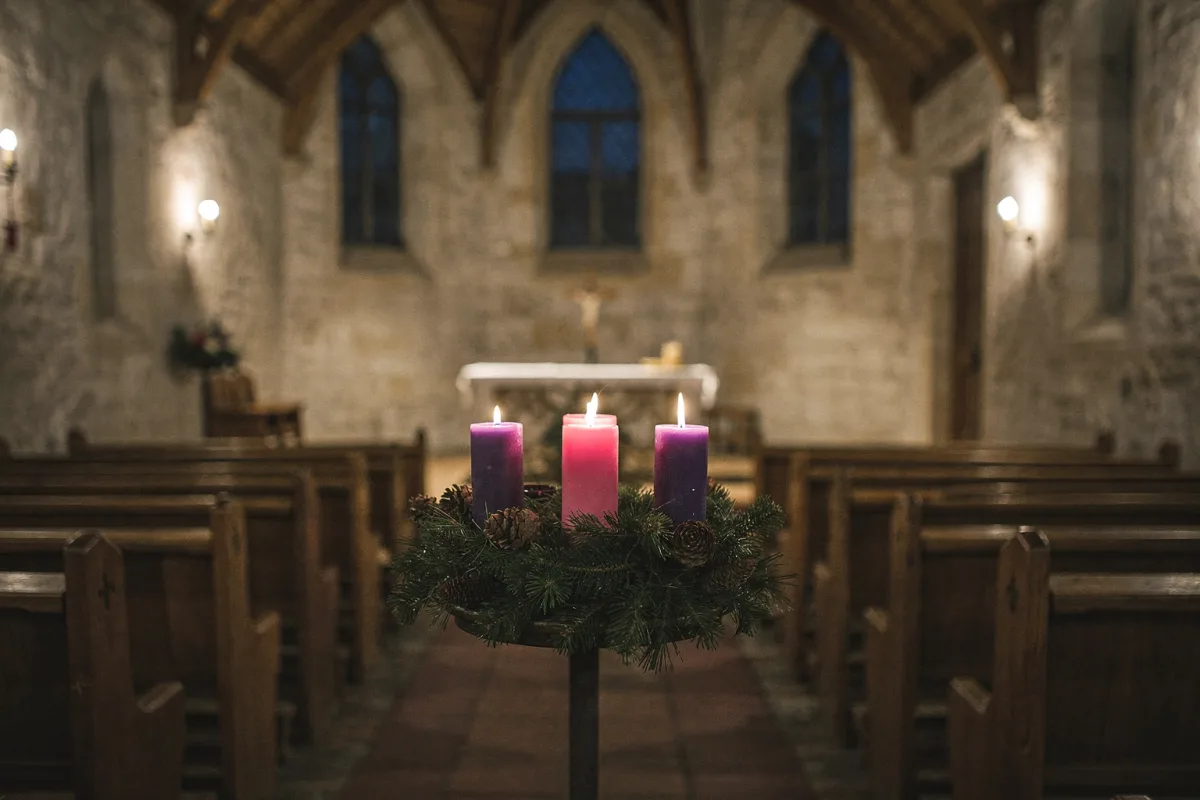
The O Antiphons are seven short prayers sung in the last week of Advent, one each evening from December 17 to December 23. Each one calls on Christ by a title from the Old Testament, beginning with "O": O Wisdom, O Lord, O Root of Jesse, O Key of David, O Dayspring, O King of the Nations, O Emmanuel. Each ends by asking him to come.
If you know the hymn "O Come, O Come, Emmanuel," you already know them: its verses are a nineteenth-century English paraphrase of these antiphons. Below is what they are, the Bible verses behind each name, and a short prayer you can pray at home on each of the seven evenings.
What are the O Antiphons?
An antiphon is a short verse sung before and after a psalm or canticle. In the Western church's evening prayer, Vespers, the antiphon in the last days of Advent frames the Magnificat, Mary's song from Luke 1:46-55: "My soul doth magnify the Lord."
The seven O Antiphons have been sung this way since at least the eighth century. Catholics pray them at Vespers in the Liturgy of the Hours, and they also appear as the Gospel acclamation at weekday Masses from December 17 to 23. Many Anglican and Lutheran churches use them too. The Church of England's Book of Common Prayer still marks "O Sapientia" in its calendar on December 16, because some English churches began a day earlier.
There is a small puzzle hidden in them. Take the first letter of each Latin title from last to first, Emmanuel, Rex, Oriens, Clavis, Radix, Adonai, Sapientia, and you get ERO CRAS, Latin for "Tomorrow I will be there."
The seven O Antiphons and their Bible verses
December 17: O Wisdom (O Sapientia)
Christ as the Wisdom of God who orders all things and teaches us the way of understanding. Paul calls him "Christ the power of God, and the wisdom of God" (1 Corinthians 1:24), and Isaiah says of the coming king, "the spirit of wisdom and understanding" shall rest upon him (Isaiah 11:2).
O Wisdom of God, you hold all things together with strength and gentleness. Come and teach us the way to live. Amen.
December 18: O Lord (O Adonai)
Christ as the Lord who spoke to Moses in the burning bush and gave the law on Sinai. "The LORD is our judge, the LORD is our lawgiver, the LORD is our king; he will save us" (Isaiah 33:22).
O Lord, you met Moses in the fire and set your people free. Come with your strong arm and set us free. Amen.
December 19: O Root of Jesse (O Radix Jesse)
Christ as the shoot from the family of King David's father. "In that day there shall be a root of Jesse, which shall stand for an ensign of the people; to it shall the Gentiles seek" (Isaiah 11:10). The same verse is behind the Jesse Tree, the family Advent custom.
O Root of Jesse, you stand as a sign for every nation. Come quickly and do not delay. Amen.
December 20: O Key of David (O Clavis David)
Christ who opens what no one can shut. "And the key of the house of David will I lay upon his shoulder; so he shall open, and none shall shut" (Isaiah 22:22). Revelation 3:7 applies the same words to Jesus.
O Key of David, you open doors no one can close. Come and lead out everyone who sits in darkness and in prison. Amen.
In 2026 this is also the Fourth Sunday of Advent.
December 21: O Dayspring (O Oriens)
Christ as the rising sun, sung on the longest night of the year in the Northern Hemisphere. Zechariah's song says "the dayspring from on high hath visited us, To give light to them that sit in darkness" (Luke 1:78-79), and Malachi promises that "the Sun of righteousness" shall "arise with healing in his wings" (Malachi 4:2).
O Dayspring, light that never fades, come and shine on those who sit in darkness and the shadow of death. Amen.
December 22: O King of the Nations (O Rex Gentium)
Christ as the king every people longs for, and the cornerstone who joins divided people into one. Haggai speaks of "the desire of all nations" (Haggai 2:7), and Paul writes, "For he is our peace, who hath made both one" (Ephesians 2:14).
O King of all nations, you make us one. Come and save the people you formed from the dust. Amen.
December 23: O Emmanuel
The last antiphon gathers the others into one name: God with us. "Behold, a virgin shall conceive, and bear a son, and shall call his name Immanuel" (Isaiah 7:14), which Matthew explains as "God with us" (Matthew 1:23).
O Emmanuel, our King and our hope, the one the nations wait for: come and save us, Lord our God. Amen.
How to pray the O Antiphons at home
- Pick a time each evening from December 17 to 23, at supper or before bed. Five minutes is enough.
- Read the day's Bible verse from the list above.
- Pray the day's antiphon, slowly, out loud.
- Read or sing the Magnificat, Luke 1:46-55, or simply its first line.
- Sing one verse of "O Come, O Come, Emmanuel" if your family likes to sing. Most hymnals print a verse for each title.
If you already pray evening prayer, add the antiphon before and after the Magnificat. Families keeping a Jesse Tree or following an Advent Bible reading plan can pray the antiphon after the day's reading.
Common questions
What does "O Antiphons" mean?
They are seven short sung prayers (antiphons) that each begin with "O" and a title of Christ. They are sung at evening prayer from December 17 to 23.
Are the O Antiphons in the Bible?
Not word for word, but every title comes from Scripture, mostly from Isaiah. The antiphons weave those prophecies into prayers.
What does ERO CRAS mean?
"Tomorrow I will be there." It is spelled by the first letters of the Latin titles read backward, from December 23 to December 17, and it is the answer to seven days of asking Christ to come.
Do Protestants use the O Antiphons?
Yes. Many Anglican and Lutheran churches pray them in Advent, and almost every Protestant hymnal includes "O Come, O Come, Emmanuel."
Keep the last week of Advent with Quiethaven
Quiethaven's liturgical calendar shows where each day falls in Advent, and the app's evening prayer gives you a quiet place to add the antiphon. For the season as a whole, see our guide to the church year and our list of Christmas Bible verses for the days after December 23.
About the author
The Quiethaven Editorial Team — The Quiethaven editorial team writes about Bible reading, prayer and the Christian year, with theological review across the Protestant and Catholic traditions the app serves.
Make it a daily habit with Quiethaven on iPhone.
Download on theApp StoreFree to download. Sign in with Apple or Google; a Quiethaven Premium subscription is required.
Keep reading
- Advent Wreath Prayers: What to Pray Each Week
- New Year Prayer: Short Prayers for New Year's Eve and 2027
- How to Read the Bible for Beginners: Where to Start
- Morning Prayer Routine: How to Start One and Keep It
- What Is the Liturgical Calendar? Seasons and Colors
Explore Quiethaven
- Bible App
- Prayer App
- Prayer Timer
- Pray Together
- Prayer Requests
- Talk to a Pastor
- Verse of the Day
- Bible Translations
- Liturgical Calendar
- Catholic Bible App
- Gratitude Journal
- Quiethaven vs YouVersion
- Quiethaven vs Hallow
- Quiethaven vs other Bible apps
- Every book of the Bible
- Verses explained
- Christian prayers
- Lives of the saints
- About Quiethaven