The Jesse Tree: Advent Readings and Symbols
By The Quiethaven Editorial Team ·
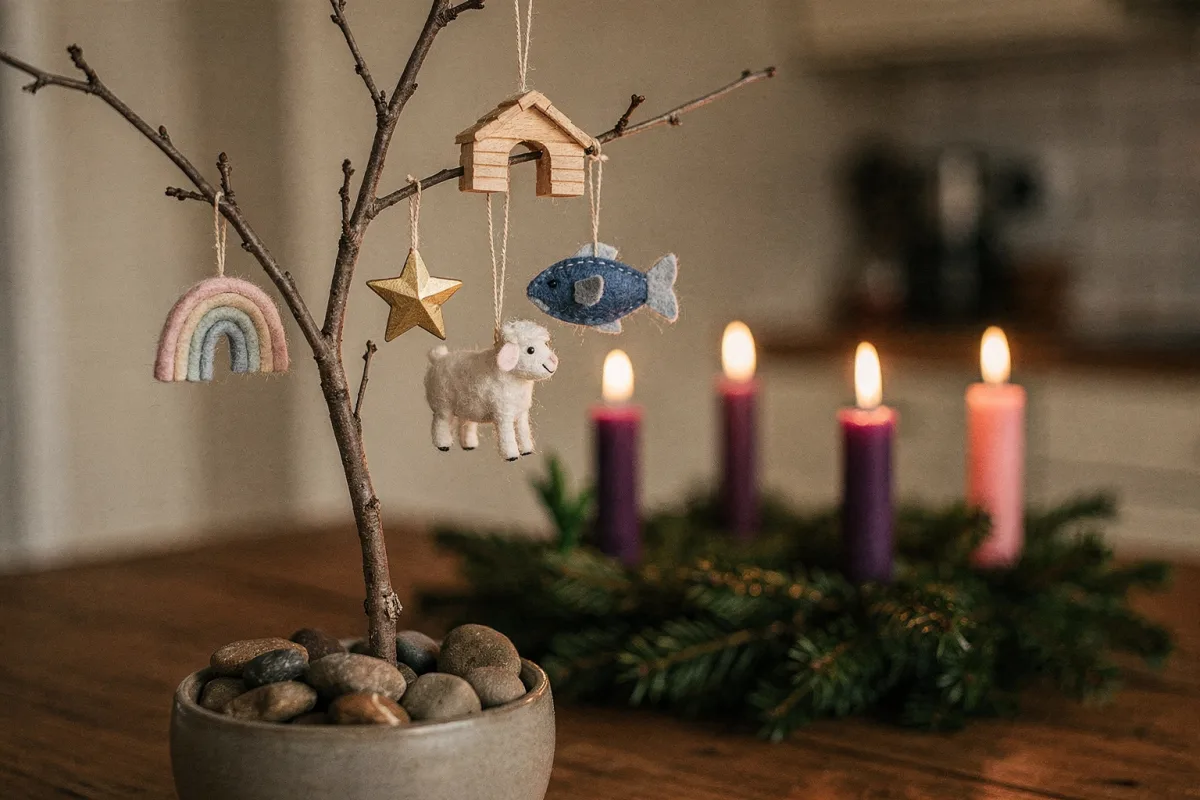
A Jesse Tree is an Advent custom in which a family reads one Bible story each day before Christmas and hangs a small ornament for it on a branch or a tree. The stories trace God's promise from Creation through Abraham, David and the prophets to the birth of Jesus. The name comes from Isaiah 11:1: "And there shall come forth a rod out of the stem of Jesse, and a Branch shall grow out of his roots."
Jesse was the father of King David. Isaiah pictured David's royal family as a tree cut down to a stump, and a new shoot growing from it. Christians read that shoot as Jesus, born into David's line. Below is a plan of 24 readings, one for each day from December 1 to Christmas Eve, with a simple symbol for each.
Where the Jesse Tree comes from
Medieval artists drew the family tree of Jesus literally: Jesse lying asleep, a vine growing from his side, and kings and prophets in its branches with Mary and Christ at the top. One of the best-known is the twelfth-century Tree of Jesse window at Chartres Cathedral in France.
The home version, a branch with hand-made ornaments, spread through Catholic and Protestant families and Sunday schools in the twentieth century. It works in any tradition because it is simply a way of reading the Old Testament toward Christmas. Paul made the same connection: "There shall be a root of Jesse, and he that shall rise to reign over the Gentiles; in him shall the Gentiles trust" (Romans 15:12).
How to make a Jesse Tree
- Pick a tree. A bare branch in a pot of stones, a small tabletop tree, a felt tree on the wall or a tree drawn on poster board all work. Some families use the Christmas tree itself.
- Make 24 ornaments. Paper circles with a drawing, salt-dough shapes or felt cut-outs. Children can draw one each evening after the reading, which makes the tree theirs.
- Choose a time. Supper or bedtime works best. One reading takes three to five minutes.
- Read, talk, hang. Read the passage, ask one question ("Why was Noah's family safe?"), hang the ornament and pray a sentence together.
Advent in 2026 begins on Sunday, November 29. Many families still start the Jesse Tree on December 1 so the 24 readings line up with the calendar. If you start late, read two stories a night until you catch up, or simply join on today's date.
Jesse Tree readings for each day of Advent
Read the passage aloud, then hang the symbol. Where a chapter is long, the verses in brackets are enough for young children.
- December 1, Creation: Genesis 1 (1:1-5, 26-31). Symbol: the sun or a globe.
- December 2, Adam and Eve: Genesis 3 (3:1-15). Symbol: an apple. Genesis 3:15 is often called the first promise of a Savior.
- December 3, Noah: Genesis 6:9-22 and 9:8-17. Symbol: an ark or a rainbow.
- December 4, Abraham: Genesis 12:1-7 and 15:1-6. Symbol: a sky full of stars.
- December 5, Isaac: Genesis 22:1-14. Symbol: a ram. "God will provide himself a lamb" (Genesis 22:8).
- December 6, Jacob: Genesis 28:10-22. Symbol: a ladder.
- December 7, Joseph: Genesis 37:1-11 and 50:15-21. Symbol: a coat of many colors.
- December 8, Moses: Exodus 3:1-15. Symbol: a burning bush.
- December 9, the Passover: Exodus 12:1-13. Symbol: a lamb.
- December 10, the Ten Commandments: Exodus 20 (20:1-17). Symbol: two stone tablets.
- December 11, Ruth: Ruth 1 and Ruth 4:13-17. Symbol: a sheaf of wheat. Ruth was David's great-grandmother.
- December 12, Jesse: Isaiah 11:1-10. Symbol: a stump with a green shoot. Isaiah 11:10 returns on December 19 in the O Antiphons.
- December 13, David: 1 Samuel 16 (16:1-13). Symbol: a shepherd's crook or a harp.
- December 14, Solomon: 1 Kings 3:5-14. Symbol: a crown or the temple.
- December 15, Elijah: 1 Kings 18:20-39. Symbol: a flame.
- December 16, Isaiah: Isaiah 9:2-7. Symbol: a lamp. "For unto us a child is born" (Isaiah 9:6).
- December 17, Jonah: Jonah 1 and 2. Symbol: a great fish.
- December 18, Daniel: Daniel 6:10-23. Symbol: a lion.
- December 19, Micah: Micah 5:2-5. Symbol: a small town on a hill, for Bethlehem.
- December 20, Zechariah and Elizabeth: Luke 1:5-25. Symbol: an incense burner.
- December 21, John the Baptist: Isaiah 40:3-5 and Matthew 3:1-6. Symbol: a shell or a river.
- December 22, Mary: Luke 1:26-38. Symbol: a white flower.
- December 23, Joseph of Nazareth: Matthew 1:18-25. Symbol: a carpenter's hammer.
- December 24, Jesus is born: Luke 2 (2:1-20). Symbol: a manger or a star.
Lists differ from family to family. Some include Rahab, Gideon or Hezekiah, and some end on Christmas Day with Luke 2 and the angels. The order matters more than the exact list: it should move from the promise to its fulfillment.
Tips for families with young children
- Tell rather than read the longer chapters, then read one key verse straight from the Bible.
- Let the oldest child hang the ornament and the youngest find the place on the tree, and swap the next night.
- Ask "Where is God in this story?" It works for every reading, from Noah to the manger.
- Don't worry about missed nights. The tree fills up anyway, and a double night before the weekend is fine.
Jesse Tree and the Advent wreath
Many families do both. The Advent wreath marks the four Sundays with candles. The Jesse Tree marks each day with a story. If you want something lighter for adults, our Advent Bible reading plan has a short passage for every day without the crafts, and our guide to what Advent is explains the season itself.
Common questions
What is the meaning of the Jesse Tree?
It shows Jesus' family history and God's promises across the Old Testament. Each ornament is one step in the story that leads to Christmas.
Who was Jesse in the Bible?
Jesse of Bethlehem was the father of King David and the grandson of Ruth and Boaz (Ruth 4:17). Matthew lists him in Jesus' family line: "Obed begat Jesse; And Jesse begat David the king" (Matthew 1:5-6).
When do you start the Jesse Tree?
Most families start on December 1 and finish on December 24 or Christmas Day. Others begin on the first Sunday of Advent, which in 2026 is November 29.
Is the Jesse Tree Catholic or Protestant?
Both. It began in medieval Christian art and is used today by Catholic, Lutheran, Anglican, Methodist, Presbyterian and evangelical families.
How many ornaments does a Jesse Tree have?
Usually 24 or 25, one for each day of December until Christmas. Some lists have 28 to cover the full length of Advent.
Follow the Advent readings in Quiethaven
Quiethaven's Plans include an Advent plan, and you can set a daily reminder so the reading does not slip on a busy evening. The Bible in the app opens each passage in a tap, and the liturgical calendar shows where you are in the season.
About the author
The Quiethaven Editorial Team — The Quiethaven editorial team writes about Bible reading, prayer and the Christian year, with theological review across the Protestant and Catholic traditions the app serves.
Make it a daily habit with Quiethaven on iPhone.
Download on theApp StoreFree to download. Sign in with Apple or Google; a Quiethaven Premium subscription is required.
Keep reading
- O Antiphons: The Seven Names of Christ, December 17-23
- Advent Wreath Prayers: What to Pray Each Week
- New Year Prayer: Short Prayers for New Year's Eve and 2027
- How to Read the Bible for Beginners: Where to Start
- Morning Prayer Routine: How to Start One and Keep It
Explore Quiethaven
- Bible App
- Prayer App
- Prayer Timer
- Pray Together
- Prayer Requests
- Talk to a Pastor
- Verse of the Day
- Bible Translations
- Liturgical Calendar
- Catholic Bible App
- Gratitude Journal
- Quiethaven vs YouVersion
- Quiethaven vs Hallow
- Quiethaven vs other Bible apps
- Every book of the Bible
- Verses explained
- Christian prayers
- Lives of the saints
- About Quiethaven