The Angelus Prayer
By The Quiethaven Editorial Team ·
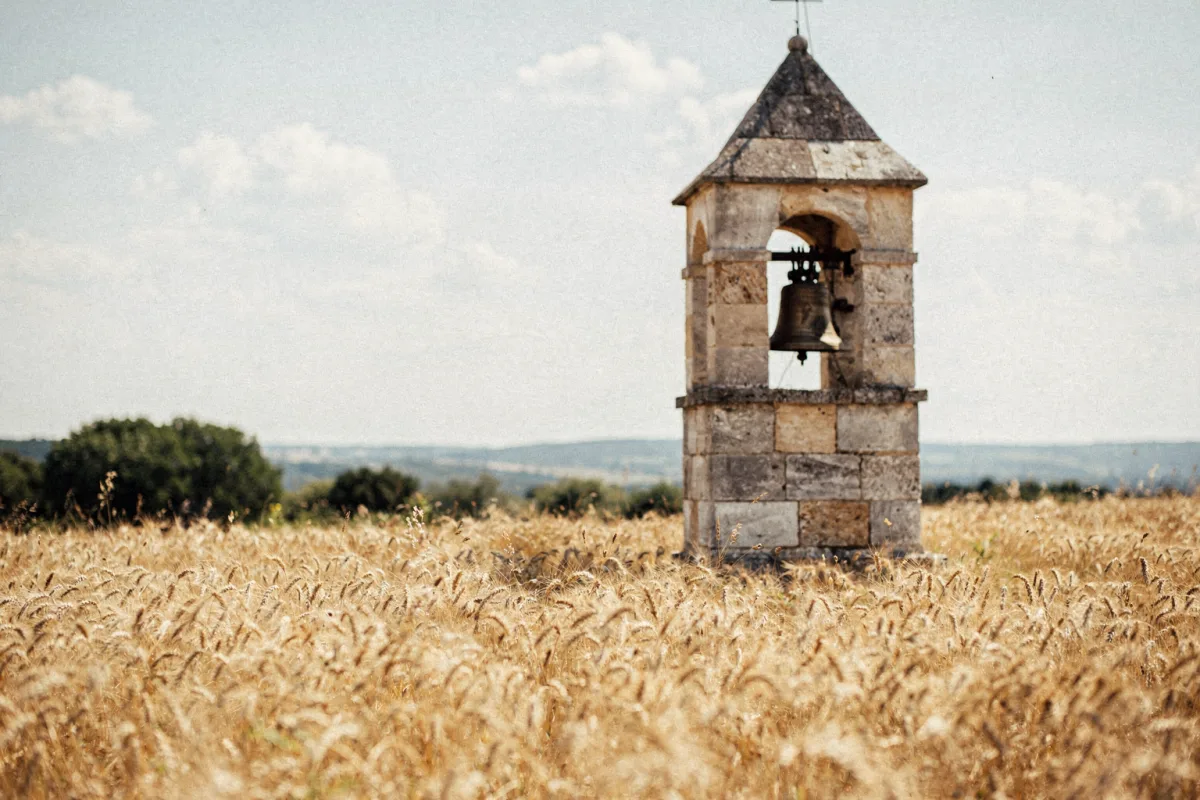
The Angelus is a short Catholic prayer that recalls the moment the Son of God became man. It is said three times a day, in the morning, at noon and in the evening, often at the sound of a church bell.
The prayer
V. The Angel of the Lord declared unto Mary.
R. And she conceived by the Holy Ghost.
Hail Mary.
V. Behold the handmaid of the Lord.
R. Be it done unto me according to Thy word.
Hail Mary.
V. And the Word was made Flesh.
R. And dwelt among us.
Hail Mary.
Let us pray.
Pour forth, we beseech Thee, O Lord, Thy grace into our hearts; that as we have known the Incarnation of Christ Thy Son by the message of an Angel, so, by His Passion and Cross, we may be brought to the glory of His resurrection; through the same Christ our Lord. Amen.
History & tradition
The Angelus began with the evening bell. In the thirteenth century Franciscan friars taught people to say three Hail Marys when it rang, in memory of the Annunciation. A morning bell and then a noon bell were added over the next two centuries, and the verses and the closing prayer were in place by the seventeenth. Each verse is drawn from Scripture: the angel's message and Mary's answer from Luke 1, and "the Word was made flesh" from John 1:14. The Pope prays the Angelus with the crowd in St. Peter's Square at noon on Sundays. The text above is from the Manual of Prayers of 1888. Many books add the verse "Pray for us, O holy Mother of God" before the closing prayer.
When to pray it
Traditionally at six in the morning, at noon and at six in the evening. Most people today keep the noon one. When two or more pray together, one says the verse (V.) and the others the response (R.), and all say the Hail Mary after each. Alone, you say both parts. From Easter to Pentecost the Regina Caeli is said in its place.
Related prayers
Regina Caeli
"Queen of heaven, rejoice! Alleluia." The prayer that replaces the Angelus in the Easter season, by a rule of Pope Benedict XIV in 1742.
Hail Mary
The prayer said three times in the Angelus. See the Hail Mary.
The Annunciation in Luke
Luke 1:26-38 is the whole story the Angelus sums up. Reading it slowly is a prayer in itself.
Pair it with daily practice
In the Catholic prayer book of the Quiethaven app for iPhone the Angelus is the midday prayer, and in the Easter season the Regina Caeli takes its place.
"And the Word was made flesh, and dwelt among us, (and we beheld his glory, the glory as of the only begotten of the Father,) full of grace and truth." — John 1:14 (KJV)
Common questions
What time is the Angelus prayed?
At 6 a.m., noon and 6 p.m. by tradition. The noon Angelus is the one most people keep.
What replaces the Angelus at Easter?
The Regina Caeli, from Easter Sunday to Pentecost.
Why is it called the Angelus?
From its first words in Latin, Angelus Domini, "the Angel of the Lord."
Pray this with Quiethaven on iPhone.
Download on theApp StoreFree to download. Sign in with Apple or Google; a Quiethaven Premium subscription is required.
Other prayers
- Morning Prayer
- Evening Prayer
- The Serenity Prayer
- The Jesus Prayer
- Prayer for Anxiety
- Prayer for Healing
- Prayer for Strength
- Prayer for Protection
- Prayer Before Surgery
- Night Prayer
- Prayer Before Meals
- The Prayer of St Francis
- The Apostles' Creed
- The Hail Mary
- Prayer for Guidance
- St. Michael Prayer
- The Rosary
- The Memorare
- Act of Contrition
- Hail Holy Queen
- Anima Christi
- Guardian Angel Prayer
- Morning Offering
- Novena
- Litany of Loreto
- Litany of the Saints
- Litany of the Sacred Heart
- Litany of the Holy Name
- Novena to the Sacred Heart
- Christmas Novena
- Stations of the Cross
- Prayer for Peace
- Prayer for Sleep
- Prayer for Hope
- Prayer for Marriage
- Prayer for Loneliness
- Prayer for Mental Health
- Prayer for Children
- Prayer for Patience
- Prayer for Friends